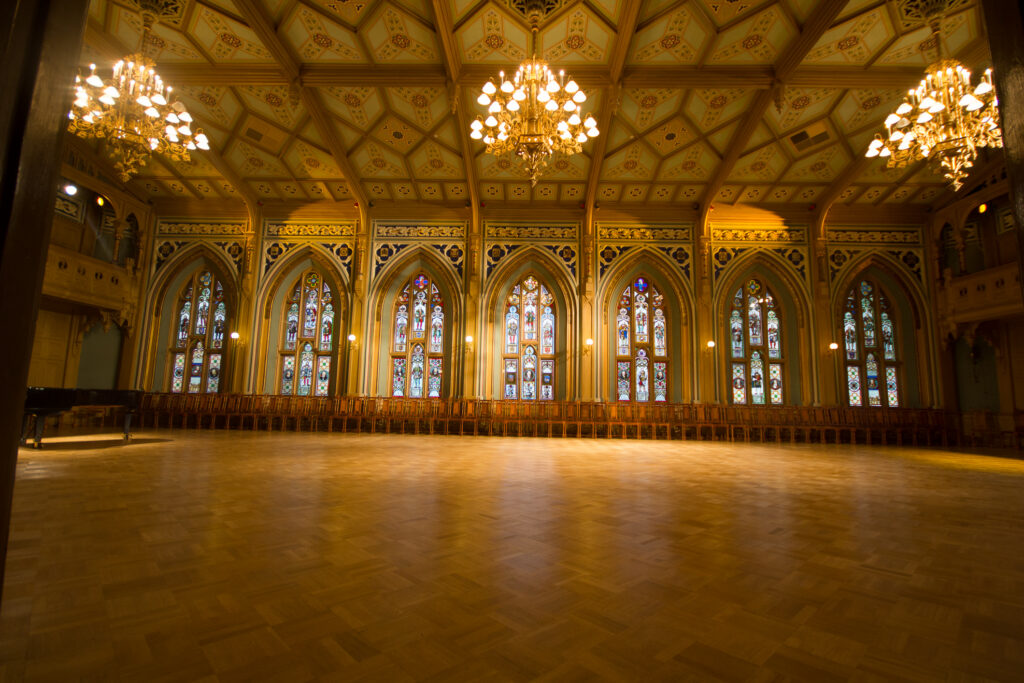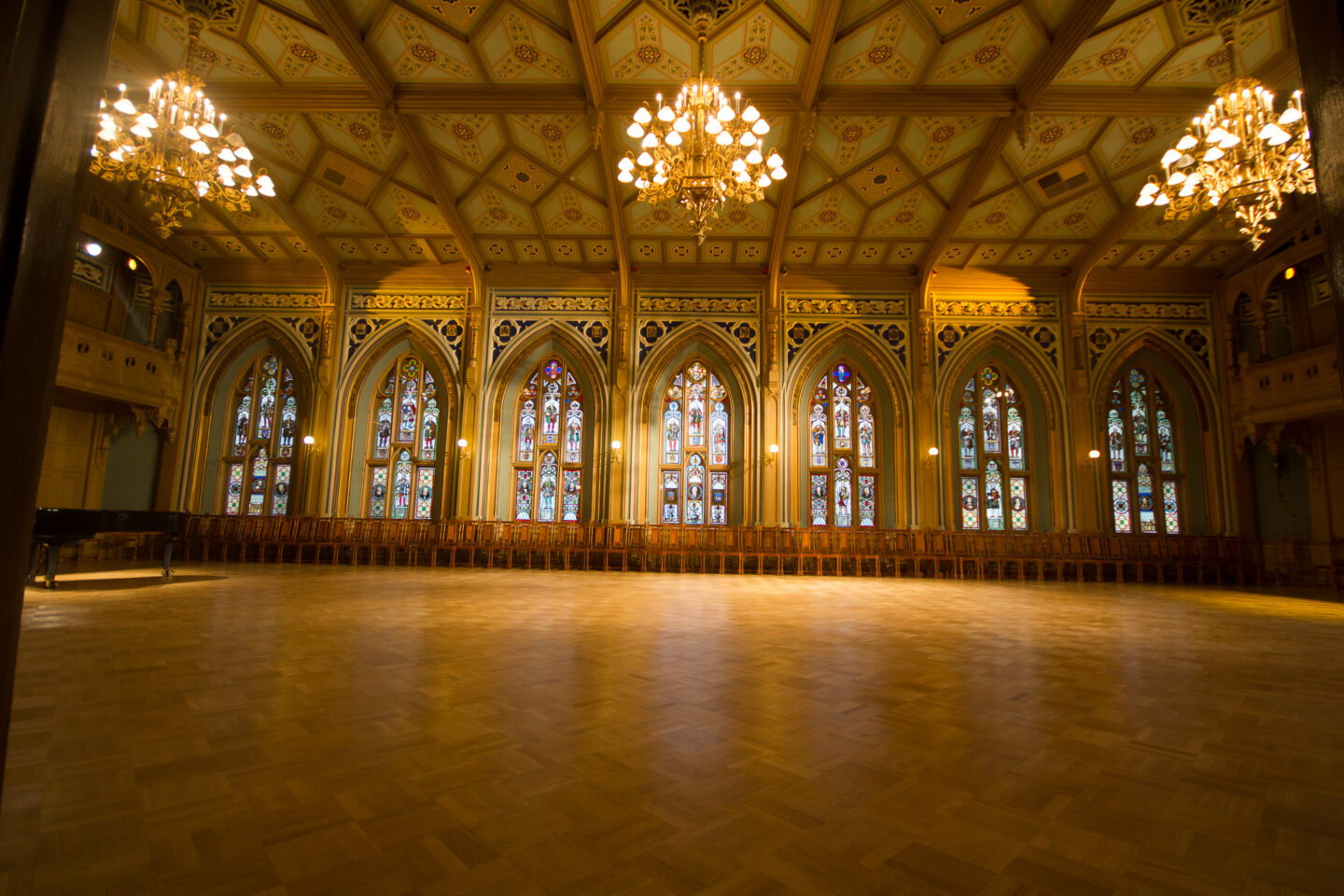

Gothic forms are used in the interior of the large hall (and the meeting halls).
The hall is richly decorated with neo-Gothic pilasters, wooden panels, painted ceilings, stained glass and paintings.
The hall has seven doorways and seven window sills. At the top of the walls are the coats of arms of various crafts, in the space above the doors – painted city panoramas (Lübeck, Bremen, St. Petersburg, Riga, Moscow, Hamburg and Rostock).
The room is illuminated by three crown chandeliers. The stained glass windows of the Great Hall, as seen today, were made in the workshop of A. A. Freystadtl in Hanover and placed in the windows of the Small Guild in 1888.
The portrait of the artist is placed in the stained glass window of the adjoining room.
There is also a stained glass portrait of Johann Daniel Felsko, the architect of the Small Guild house.
In the stained glass windows of the Great Hall, the principal place is given to the full-length portraits of the elders of 25 fraternities of different trades, in traditional costumes with appropriate emblems.
In addition, the stained glass windows housed nine stained glass portrait medallions of the benefactors of the Small Guild who had donated funds and established various charitable institutions – orphanages, shelters for widows and the disabled, benefit funds.
The sharp-bow edges of the hall’s door and window openings are adorned with painted instructive aphorisms. For example: “Whoever does good to his enemy shows the highest gallantry,” “Where work keeps the house safe, poverty does not enter.”
The large hall has windows, doors, balconies, wooden parts of the ceiling, wall panels and shutters, preserved from 1888.
As a result of the restoration of the house, there is an opportunity to go out on to a beautiful outdoor balcony overlooking Livu Square and the front garden of the Small Guild with a metal fence, the drawing of which was reconstructed after the Guild images from 2nd part of 19th century.
The Hanseatic League began to form in the middle of the 14th century. The Hanseatic League was a medieval German merchants’ organization that gradually expanded into an international political union of about 300 cities from the Baltic and North Sea basins.
Its aim was to ensure the protection of mutual interests and to promote overseas trade in Northern Europe.
Eight Latvian cities of that time were part of the Hanseatic League, and Riga was one of the main Hanseatic cities.
The regular meetings of this union were called the “Hanseatic Days”.
The Riga Culture and Folk Art Center “Small Guild” has a very close connection with the former Hanseatic League – paintings and coats of arms of the Hanseatic cities can be seen both in the lobby and in the halls.
The Hanseatic Days are actively celebrated not only in Riga, but also in other cities of the Hanseatic League.