Children’s and Youth Theatre Studio “Vinnijs”
The amateur film studio “Ģilde” began its creative journey in September 1958 as the “Public Film Studio of the Culture House of the Trade Union Council of the Republic of Latvia”. One of its key founders and long-standing leaders was Osvalds Dinvietis, a graphic artist by profession and a pioneer of amateur cinema.
Invited by Modris Šubiņš—then artistic director of the Culture House—Dinvietis joined the newly established amateur cinema club. Initially operating as a series of lectures where professional filmmakers shared their craft, the club soon transitioned to practical filmmaking.
Out of a large group of film enthusiasts, a dedicated core team emerged: Elmārs Riekstiņš, Edgars Agriņš, Juris Zemitāns, Jānis Podskočijs, Visvaldis Vanags, Šarls Taics, and Osvalds Dinvietis. Leadership was entrusted to Dinvietis until the 1970s, after which his wife Regīna Dinviete gradually took over, followed by Romualds Pipars in the 1990s. Over the decades, around twenty filmmakers actively worked within the studio, serving as a launching pad for many who later transitioned into professional cinema.
In the winter of 1961/62, Šarls Taics conceived the idea of creating a film using stop-motion cutout animation. Utilizing a 16mm newsreel camera capable of single-frame recording, the studio produced its first experimental animated works.
Relying entirely on self-education, the team created “216. Istabas noslēpums” (The Secret of Room 216)—a cutout parody of action-packed gangster movies. Shown at the 1962 Republic Amateur Film Showcase, it gained attention from professional Soviet filmmakers. The team was invited to recreate the film at the Riga Film Studio (Šmerlis), paving the way for the development of professional puppet animation in Latvia led by Arnolds Burovs. Dinvietis later contributed to other cutout animation films, including “Perpendikuls” (Perpendicular) and “Horoskops” (Horoscope).
In 1965, Osvalds Dinvietis initiated Latvia’s first hand-drawn animated film, “Problēma” (The Problem). Following its success at the 1966 Republic Showcase, the film was selected for the prestigious UNICA International Amateur Film Congress in Mariánské Lázně (Czechoslovakia), where it was awarded a Bronze Medal. To this day, “Problēma” remains the studio’s sole hand-drawn animation. Other members also explored animation techniques, such as Vaitkuss (“Atriebība” / Revenge) and Romualds Pipars (“Mana ragainā mīlestība” / My Horned Love).
Another standout dimension of the studio’s work was “PHOTO-FILMS”—an experimental genre combining dynamically filmed photography with synchronized soundscapes and music. Iconic works included “Aptumsums” (Eclipse), “Runājiet, kalni!” (Speak, Mountains!), and “Siseņu lietus” (Rain of Locusts). When “Aptumsums” was broadcast on USSR Central Television, it drew high praise across the industry for demonstrating how a compelling cinematic experience could be crafted “out of nothing.”
Long before the advent of digital graphics, the studio created the experimental film “Serpentīns” (Serpentine), utilizing solarization techniques to achieve visual effects remarkably similar to modern computer graphics.
The studio also excelled in fiction comedy, considered one of the most challenging genres in amateur cinema. Their most celebrated feature, “Mārtiņš”, became one of the most highly awarded films across amateur film festivals of that era.
During the height of amateur filmmaking between 1975 and 1985, around 400 amateur films were produced annually in Latvia, with only the top selection screened in Riga.
In 2014, utilizing archive footage captured by studio members alongside other historical materials, the full-length documentary “Monētas dubultportrets” (Double Portrait of a Coin) was created, telling the story of life in Latvia over a 70-year period.
From April 26 to June 8, 2014, the film was featured at the National Gallery of Art in Washington, D.C. as part of the film series “Artists, Amateurs, Alternative Spaces: Experimental Cinema in Eastern Europe, 1960–1990”. With the filmmakers’ consent, “Monētas dubultportrets” was officially added to the permanent collection of the National Gallery of Art.
The weaving group launched its activities in 1978, and in 1986, the collective was awarded the title of Applied Folk Art Studio “Kamene”. Since 1997, its home has been the Riga Culture and Folk Art Center “Mazā Ģilde”. Since 1983, the studio has been led by Marina Sproģe, a graduate of the Applied Arts Secondary School and the Textile Art Department at the Art Academy of Latvia.
Alongside practical sessions, studio members learn weaving theory, color theory, and the fundamentals of composition, with the studio leader working individually with each participant. The weavers study museum archives and collections, learning to appreciate the simplicity, practicality, and richness of colors preserved through the centuries to incorporate the diversity and splendor of Latvian folk patterns into their own work.
Over the years, the range of fabrics woven by the studio members has been extensive: blankets, tablecloths, wall hangings, towels, floor runners, and decorative fabrics—everything that can make an interior warm and cozy. Members also weave modern fabrics, including cloaks, linen scarves, and wearable textiles.
As the Song and Dance Festival approaches, the studio members pay increased attention to crafting details for folk costumes, already weaving skirt fabrics and sashes for the upcoming festival.
To create their works, the studio weavers use natural materials, with flax/linen, wool, and cotton being the most preferred. Both chemical and plant dyes are used to dye the yarn.
Over time, the composition of Applied Folk Art Studio “Kamene” has evolved, with 35 members currently actively participating. The weavers are united by a love of their craft and eagerly share their experience with newcomers.
The priority of Applied Folk Art Studio “Kamene” is to cultivate, preserve, and pass on to future generations the traditional craft of folk weaving, developed and nurtured over centuries. Over time, a distinct character has developed in the studio’s works, characterized by high quality, vibrant colors, and nuanced detail.
Studio members participate in collective as well as thematic national folk art exhibitions. Works by Applied Folk Art Studio “Kamene” have also represented Latvia abroad: in Estonia, Lithuania, Sweden, Russia, Germany, Spain, Japan, and Australia. Several works are included in the collection of the National History Museum of Latvia.
Every opportunity to display their creations in Latvia and abroad is a celebration that brings satisfaction and confidence that these ancient skills are still essential today. The studio regularly holds retrospective exhibitions, as well as traveling exhibitions across Latvia’s regions and beyond its borders.
It all began in 1976 with a wicker weaving group led by Silvestrs Kušners at the Culture House of the State Vocational Education Board. A year later, Master Folk Craftsman Vilhelms Tupiņš took over the leadership, guiding his students until the collective earned the title of Applied Folk Art Studio “Tīne” in 1986. In 1987, Master Folk Craftswoman Edīte Laiviņa assumed leadership of the studio. Since 1997, its home has been the Riga Culture and Folk Art Center “Mazā Ģilde”.
For their creations, the studio members use willow osiers and strips, pine and spruce roots, bulrushes, and other natural materials. The members’ woven crafts have been showcased in numerous retrospective exhibitions, thematic displays, local and national folk art exhibitions, as well as traveling exhibitions across Latvia and beyond its borders.
We would be truly delighted if our work in preserving folk art traditions and ancient crafts inspires someone to spend their free time in an enjoyable and meaningful way, and to join our community.
Studio “Ģilde” launched its activities nearly 70 years ago. Its members are amateur artists of various ages, professions, and backgrounds. Studio classes take place twice a week, where artists paint still lifes, portraits, landscapes, or figural compositions, most frequently in oil technique. Some members also enjoy working with pastels or watercolor. The main focus is realism, aiming for professional-level painting. Some authors’ works showcase characteristic features of naive art, while the younger generation of participants is bolder, painting in a modern, expressive style and not afraid to experiment.
Studio members organize not only their personal exhibitions but also participate in studio, Riga city, and national exhibitions. Exhibitions have taken place not only in Riga, but also in Jūrmala, Lielvārde, Carnikava, and other cities. In spring—in April and May—the traditional Art Days take place across all of Latvia. Studio “Ģilde” members regularly participate in Art Days exhibitions, consistently earning acclaim for their work.
Despite a changing membership over time, the studio collective remains very close-knit and friendly, warmly welcoming new members while honoring studio veterans. The studio leaders—professional artists and outstanding creative personalities including Jānis Liepiņš, Hiliels Komrass, Eduards Jurķelis, Kurts Fridrihsons, Aleksandrs Zviedris, Andrejs Ģērmanis, and Juris Ģērmanis—have made immense contributions to uniting the collective and maintaining a creative atmosphere. From 1986 until the autumn of 2020, the studio was led by the painter Ausma Danemane.
Classes take place on Wednesdays and Thursdays from 19:00 to 21:00.
Since 2025, the children’s art studio, originally nurtured by Kristīne Otersone, has been led by Anda Poikāne.
The studio accommodates 10 young artists aged 6 to 16. Each month, the children paint and draw a wide variety of topics and elective assignments using various visual art techniques, including gouache, watercolor, oil pastels, pencils, ink, and markers. Their artwork is regularly showcased in thematic exhibitions at the Culture and Folk Art Center “Mazā Ģilde”. The children also have the opportunity to participate in various visual art competitions and projects.
Studio leader Anda Poikāne sees her main goal as discovering and developing the unique artistic talent and abilities of each participant, emphasizing diversity in approaching any topic or task.
A creative studio atmosphere and the exchange of ideas are also essential components of the artistic process.
In 1995, directors Ingūna Gremze and Karīna Šišlo established the theater studio “Vinnijs”, staging their first production based on A. A. Milne’s book, “Winnie-the-Pooh and His Friends”.
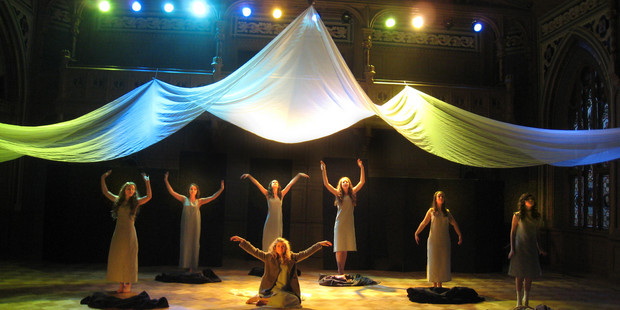
The theater studio operates several age groups: children aged 6–12, youth aged 13–18, and students up to 26 years old. Participants learn the fundamentals of acting, stage speech, movement, and improvisational theater. Every year, the studio stages several productions, which are regularly performed in Riga, across Latvia, and at festivals. “Vinnijs” has formed close friendships in Sweden, Austria, Denmark, Norway, the UK, and Finland through participation in international festivals and by organizing the International Children and Youth Theater Festival “Baltic Bell” every two years. In 2005, the “Bear” project was realized, where amateur ensembles from Norway, Sweden, Finland, and Lithuania staged A. Chekhov’s play, performing the show in each country.
An interesting collaboration took place between theater directors Ingūna Gremze, Karīna Šišlo, and Finnish director Maire Saure, staging H. Paukšs’ play “Our Common Home” (2006).
In 2008, theater studio “Vinnijs” participated in the International Children’s Theater Festival KUULAS in Kuusankoski, Finland, with the performance “We Love Him Just the Way He Is!”. This festival is notable for bringing together both professional actors and children’s groups from Finland and abroad. The 21st edition of the festival was held under the patronage of Tarja Halonen, the President of Finland; participation served as a dress rehearsal before traveling to the World Festival of Children’s Theatre in Moscow. Continued collaboration takes place with the Helsinki Arts Centre Annantalo. Director Maire Saure wrote a script based on researched facts about Riga’s history—including the Black Cat House, the Great Guild, the Small Guild, and their significance in the history of Riga—resulting in the musical performance “The Black Cat”, featuring music composed by Sami Baldauf and performance by actor Taisto Oksanen. The show was presented during “Riga City Festival 2009” and also toured at the House of Nobility (Ritarihuone) in Helsinki.
The production “Skalbe”, created from philosophical fairy tales, was dedicated to K. Skalbe’s anniversary.
The production “Sven Reads Peer Gynt”, based on H. Ibsen’s work, became a major success, earning Sven Blūms the Best Actor award at the theater festival “Rīga spēlē teātri” (Riga Plays Theater).
In 2014, W. Shakespeare’s play “Romeo and Juliet” was staged, with Ermelinda Kuļiša receiving acclaim for her performance as Juliet. A production of “Max and Moritz”, based on the work by W. Busch, was created with the youngest group.
- “Tidlibums” (based on A. A. Milne’s Winnie-the-Pooh)
- Rainis – “Pūt, vējiņi!” (Blow, Wind!)
- Aspazija – “Vaidelote”
- A. Chekhov’s plays “The Proposal” and “The Bear”
- “The Curious Savage”
- H. Paukšs – “Cir, čir”, “Little Red Turban”, “Our Common Home”
- Movement, poetry, and improvisation performance “Colors”
- W. Shakespeare – “A Midsummer Night’s Dream”
- Rutku Tēvs – “Vella kalpi” (The Devil’s Servants)
- “Town Musicians of Bremen”
- “The Boastful Hare”
- “Hedgehog’s Coat”
- “Max and Moritz”
- “Cinderella”
- “Thumbelina”
- “Arkens and Parkens”
- “We Love Him Just the Way He Is” (based on Astrid Lindgren’s Emil of Lönneberga)
- “Skalbe”
- “Lelīte Lollīte”
- “Sven Reads Peer Gynt”
- “Eight Critters”
- “Romeo and Juliet”